

Why Climate Rubik is relevant and important in the era of AI Chatbots
David vs Goliath battle on independent Climate research and writing.
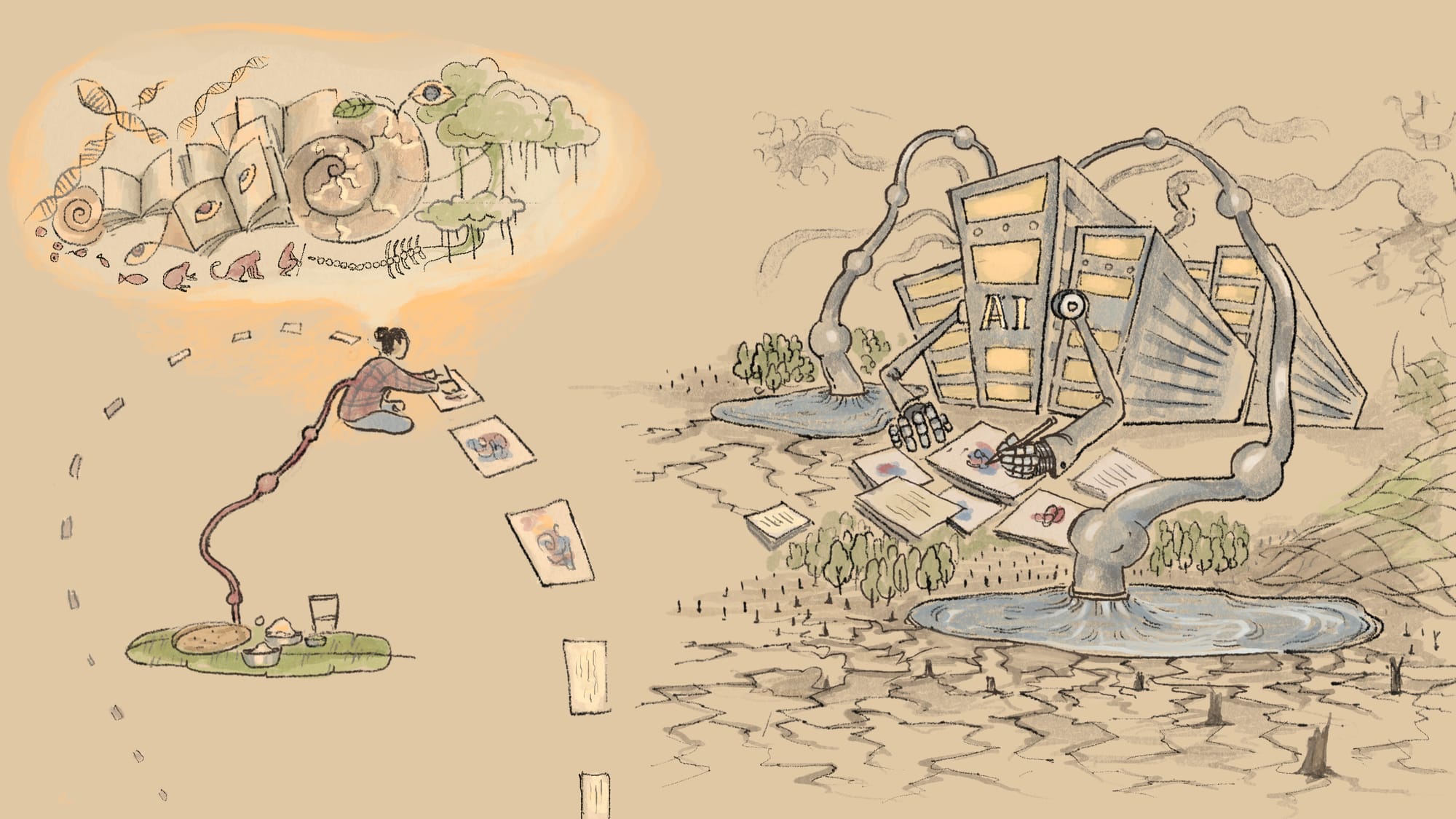
We increasingly live in an age of information abundance. The challenge tends to be of quality rather than quantity. How to sort through the vast troves of data, commentary, and existing available research to find the most relevant information to answer the question you have in mind.
Google search has been very effective at this function, though not perfect. Many users have also complained about its declining usefulness in more recent years, as the platform is given over more to advertising, its algorithm increasingly gamed, and to some extent a general increase in distracting, wasteful “noise” on the wider internet, which it draws from.
In that context, technology companies today present artificial intelligence in the form of large-language models (LLM) as much improved form of retrieving and presenting the most relevant information for any query or request a person might have.
These AI chatbots are computationally intensive as they are developed to answer your queries by statistically predicting word sequences from being trained on massive datasets from the internet. The answers generated by these AI chatbots can go into great depth and may be tailored to a high degree, depending on the quality of the input “prompts” that are entered.
This works fine perhaps for most kinds of information you may seek. However, when it comes to climate change, there are several reasons why we feel strongly that people should not rely solely or even primarily on AI chatbots for their information.
Let's dive into these reasons through an objective case study of comparing the output of our article on having kids (or not) in the context of Climate crisis with the ChatGPT version of the article.
When we did the comparison, following factors stood out:
Quality and efficiency: We found out that the quality of writing in our article was as good as the ChatGPT version, but obviously it did come at the cost of efficiency. We took a month to do the conceptualization, necessary secondary research, revisions etc for the article while ChatGPT outputted the draft in a minute. On this parameter, we can’t compete at all.
Localization and Emphasis: We found out that ChatGPT covered all the nuances on the given topic in a very dry fashion, but we were able to localize the nuances better and give emphasis on factors which mattered more to the readers from the Global South. This is not surprising as AI chatbots are able to tailor answers very closely to what you are looking for. Yet at the end of the day, in their current form, they remain probability machines. So while they may point you in directions that merit further enquiry, you cannot count on them to take a deeply considered approach to weighing important, high-stakes questions like those around climate (whether the place you live is too risky in the long-term for your comfort, how you should approach your personal financial investments considering climate risks etc.). Chatbots are trained to be politically correct or neutral while our platform will be authentic in presenting unfiltered views.
Also, Climate Rubik has the scope to emphasize real time climate insights based on changing ground realities, which AI chatbots will have a lag on. As Climate Rubik expands and evolves, our website becomes the source of ‘clean information and datasets on climate’ to the training of future LLM’s and to improve the output of existing LLM’s through Reinforcement learning from human feedback (RLHF) technique.
Energy/Carbon footprint: On this parameter, Climate Rubik wins easily as visiting a static website page is on an average 5-10x lower energy footprint than a LLM query inference which is processed through energy guzzling datacentres. It is worth noting here that this comparison doesn’t include the one-time footprint of training the LLM model, which is the most energy intensive phase of the LLM lifecycle. However, with time and millions of users, LLM inference footprint dominates model training footprint. Further, these data centres also have a significant water footprint which can unfairly affect local communities based on the location of datacentres and water availability there.
So how do we weigh the above factors?
As we get more readers with time and some of them decide that coming to Climate Rubik is ‘sufficient’ over visiting AI chatbots to get their dose of critical climate summaries, then this does have a significant environmental impact and decentralization of reliable climate information.
Other factors in favour of Climate Rubik, outside of the above case study, are:
Agency and Autonomy: Climate Rubik is a place that will try to stoke your curiosity around all manner of climate change related issues and how they affect you, your friends and loved ones, equipping you well to think in ways that will serve you well in the years ahead, regardless of the direction AI or any other technology takes. You will develop critical thinking autonomy by following and engaging with our work, rather than just falling back on the crutch that AI-generated information can easily become. We look out for the best interests of our readers, which necessarily doesn’t apply to AI Chatbots as they continue to improve on two major safety related themes: hallucinations and alignment. There is also the persisting criticism of ‘stochastic parrots’ on LLM’s and potentially humans using these LLM’s will become that as well if we completely outsource our critical thinking to these AI chatbots.
Trust and Empathy: Rajesh is using his past oil and gas industry experience to bring critical climate summaries through the energy lens. This is naturally more trustworthy for the readers than AI chatbots, as firsthand, insider experience brings its own heft and utility for the readers. Further collective of independent writers on this platform builds trust and community with time. We will publish articles as we see which climate subtopics are pressing for the readers. So, empathy is built into our processes and in other ways which AI chatbots don’t.
Turning content into relationship: Chat Bots could be a source to communicate back and forth as an information provider but can never turn into a relationship for people. We are developing a strong community of writers who support each other in various ways and our platform could potentially build relationships between the writers and the readers, which will evolve with time.
Having said the above, we do use AI for article title refinements, converting tables into graphs etc and is a productivity booster indeed for all writers. But it can’t help Climate Rubik to decide to what article to publish next on the platform. That is a complex question which requires human empathy intelligence which is not yet found in AI! The writer's critical first-principle thinking is still important to address and highlight the local climate realities.
To paraphrase from a Ghost newsletter, AI still has trouble generating dimension, depth, and complexity that only a human with lived experiences can create. That just means our content is real.